HMD’s Sanmeet Kochhar Maps Out What’s Next for Nokia and Pakistan’s Phone Market
Two years after calling Pakistan a "key market," HMD's Sanmeet Singh Kochhar opens up on device financing, the Nokia brand's future, and why feature phones are becoming a growth category, not a fallback.
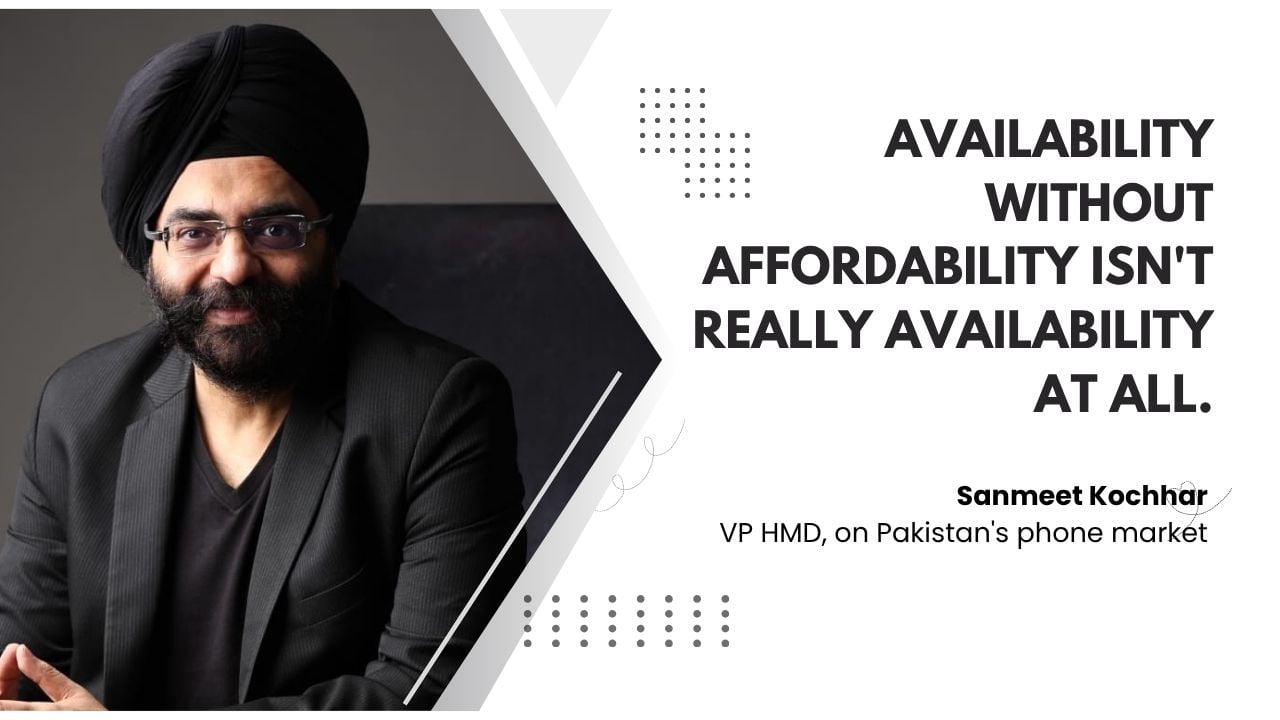
Pakistan’s phone market runs on contradictions rarely seen in more developed economies, a country building 5G infrastructure while millions still rely on 2G for their first taste of connectivity. Few executives are better placed to explain that paradox than Sanmeet Singh Kochhar, who oversees HMD’s business across Asia, the Middle East and Africa. In an exclusive conversation with PhoneWorld, Kochhar addressed the questions that have followed HMD and Nokia for months: where the licensing arrangement stands, why feature phones are making a comeback among digitally fatigued adults, and how Pakistan’s affordability crunch is reshaping product strategy from the ground up.
About Sanmeet Kochhar: Sanmeet Singh Kochhar is Vice President at HMD Global, responsible for strategy, operations, and business across the Asia, Middle East, and Africa regions, with a specific mandate to strengthen Nokia’s standing as a consumer brand there. A mechanical engineer with an MBA from the Management Development Institute, Gurgaon, he has spent more than a decade with Nokia, Microsoft, and HMD Global, holding senior roles spanning sales, channel development, and business operations across multiple countries. Earlier in his career, he worked at Colgate-Palmolive and Dabur India.
PW: HMD has called Pakistan a key market in the past. Two years into that push, how has HMD’s actual strategy for Pakistan evolved, pricing tier, retail footprint, local manufacturing or assembly, and where does the country rank today against other markets in the Asia, Middle East and Africa region you oversee?
SK: Two years in, Pakistan has genuinely earned the “key market” label. We’ve especially become more competitive on 2G feature phones, because that’s still where a meaningful share of the country buys its first or second device. Alongside that, we’ve been actively building the HMD brand itself across both feature phones and smartphones, along with our Nokia device portfolio.
The bigger shift, though, has been around access. We’ve put real focus behind device financing, because for a lot of Pakistani consumers, a key constraint has been paying for a smartphone upfront. Our retail footprint has become noticeably stronger too, particularly in the north of the country. And on manufacturing, we’ve had two local assembly facilities operating in Pakistan for several years now, and we’re actively exploring what expanding that could look like.
Against the other markets I oversee, Pakistan is consistently one of our stronger performers, and that’s not just because of its size. The engagement, the pace at which the HMD brand is gaining recognition, and the depth of our distribution all justify the investment we’ve made here.
PW: There’s real uncertainty right now about where the Nokia name goes from here; some reports point to the licensing arrangement extending, others suggest HMD is moving fully to its own brand for smartphones. Can you clarify where things stand?
SK: I understand the curiosity, and I do want to clarify this. HMD operates a multi-brand approach today, and that’s deliberate. We have HMD, which encapsulates our own-brand phones and accessories portfolio. We have Nokia feature phones, which continue to be a core part of our business. And we have exciting new collaborations that bring fresh energy to the portfolio.
What I can confirm clearly is that we will continue to sell Nokia feature phones. That’s not a transitional position; it reflects the fact that Nokia feature phones serve a real and growing audience in Pakistan and globally. Beyond that, our multi-brand strategy gives us the flexibility to bring the right product to the right market under the brand that best serves the consumer.
PW: There’s a growing conversation globally around social media detoxing, “dumbphone” trends, and younger users deliberately stepping back from smartphones. HMD has one of the strongest feature phone portfolios in the industry. Are you seeing this show up in actual demand data yet, and does it change how HMD thinks about feature phones, not as a legacy category, but as a genuine growth opportunity among younger users?
SK: Yes, and this has moved well beyond a conversation; we’re seeing real demand. Our Better Phone Project surveyed over 37,000 parents and children globally, and what it revealed is a genuine contradiction at the heart of modern parenting: families want connectivity for safety and staying in touch, but they feel they’ve lost control over what a smartphone opens the door to on day one. Young people themselves told us something striking: many recognised their relationship with their phone wasn’t healthy but felt powerless to change it because their entire social world lives on those platforms.
That research has directly shaped our product decisions. Devices like our Nokia 4G feature phones, calls, messaging, basic connectivity, no app stores, and no social media aren’t a step backward. For a parent in Karachi, Lahore, or even Dubai, they’re a considered first device for a child. And we’re seeing a second audience grow fast: digitally savvy adults who already own a premium smartphone and are deliberately buying a simpler device as a companion for weekends, travel, or simply to create space from the constant pull of notifications.
So to answer directly, yes, this changes how we think about feature phones. They’re not legacy; they’re a growth category with two distinct and expanding audiences. In a market like Pakistan, where affordability and dependability already drive feature phone demand, the digital wellbeing angle adds a genuinely new layer of relevance on top of what was already a strong commercial case.
PW: With component costs, DRAM, chipsets, modems, rising industry-wide this year, how is HMD managing pricing without ceding ground to more aggressive low-cost competitors?
SK: Memory prices have moved more in the last two quarters than in the previous two years, and it’s the affordable tier, entry 4G smartphones and low-cost feature phones especially, that feels it first, because the margin at that end was always thin.
We’re not going to chase a race to the bottom. What we are doing is locking in component supply earlier, qualifying chipsets harder before a design gets committed, and in some cases accepting a slightly higher landed cost rather than cutting something a consumer will notice within a year. That last point matters a lot in markets like Pakistan, where a phone has to last and perform, because for many buyers, it’s the single biggest piece of technology they own. Competing on price alone by compromising build quality or software support is a short-term game, and it’s not one we’re interested in playing.
PW: Pakistan’s 2G user base has stayed unusually large even as 5G rolls out elsewhere. What’s your own read on why that persists here specifically, and does it change how HMD thinks about the market?
SK: This has less to do with appetite for newer technology and everything to do with what a phone actually costs here. A 5G-capable device still runs north of PKR 50,000 once duties are factored in, and 4G and 5G networks are still being built out beyond the major cities. For most of these users, a feature phone isn’t a stopgap; it’s the sensible, practical choice.
That reality absolutely shapes how we think about Pakistan. It’s why we keep investing seriously in the 2G and 4G feature phone tier rather than treating it as something the market will simply outgrow. In many other markets I oversee, the conversation has moved to replacement cycles and ecosystem products. Here, first-time connectivity is still a very real opportunity, and building devices that meet people where they are, rather than where analysts think they should be, is where we see our biggest responsibility and our biggest commercial opportunity.
PW: Looking at the next 12 to 18 months, what should Pakistani consumers actually expect from HMD, new device categories, price points, and retail partnerships, and is there anything in the pipeline you can share now?
SK: Expect us to keep leaning into the segments that match how people here actually buy and use phones: rugged devices for anyone working outdoors or in tough environments, affordable smartphones priced for real budgets, and smarter 4G feature phones that do more without asking for a smartphone-sized wallet.
I won’t put specific model names or dates on the table today, but the direction is set, and it’s consistent with what we’ve been building. Durability and value stay the priority over chasing specifications. We’ll continue deepening our retail and distribution partnerships, particularly in areas where our presence is still growing. And device financing will remain central to how we make our portfolio accessible here, because in a market like Pakistan, availability without affordability isn’t really availability at all.
Mobile Phone Taxes Portal
Find the PTA Taxes on All Phones on a Single Page using our Taxes Portal.
Note: Mobile phone tax rates and calculations fall under the jurisdiction of the Federal Board of Revenue (FBR), not the Pakistan Telecommunication Authority (PTA).
Explore NowFollow us on Google News!

